
Practical guide to the Native American flute
Choosing, understanding and caring for your Native American flute
Everything I hand over with each flute: choosing yours, understanding how the sound is made, adjusting the totem and caring for the wood. To learn to play, head to the page Playing the flute.
Choosing your flute
Single, double or triple?
The single flute, the siyotanka of the Lakota, is the traditional flute: one voice, ideal for beginners.
The double flute, also called a drone flute, plays the melody while holding a continuous note, the drone. The sound becomes richer, almost like two musicians.
The triple flute adds a third voice: the melody in the middle, the low notes on one side, the drone on the other. Three truly distinct voices, blending into a full, enveloping sound.
Low or high?
The longer the flute, the lower it sounds. I make flutes from the bass in low A to the little flute in high E. Low flutes have a deep, enveloping voice, but need wider finger spacing. Mid-range flutes, from E to A, are the easiest to start with. High flutes are light and singing, and the notes of the upper octave come out effortlessly.
432 Hz or 440 Hz?
440 Hz is the standard tuning of modern instruments: choose it to play with other musicians.
432 Hz is slightly lower and softer. It is often called the frequency of the heart. Many musicians and sound practitioners say it resonates with the Earth, whose natural vibration, the Schumann resonance, is close to 8 Hz, and with water, which makes up about 60% of our body. The Japanese researcher Masaru Emoto even photographed water crystals that, according to him, form more harmoniously when exposed to gentle music.
These are intuitive approaches rather than scientific certainties: the fairest thing is to listen to both and choose the one that does you good. Compare them in the scale player.
How it works
How the sound is made
The breath first passes through a compression chamber, then a channel that spreads the vibration. It’s this chamber, placed at the start, that gives the flute its round, warm sound.
The totem pushes the air onto the splitting edge, which splits the flow in two and creates the whistle. Part of the air escapes; the rest ripples through the tube until it finds a way out.
With all holes covered, the air travels the whole tube: the sound is low, full and deep. With all holes open, it escapes at the first hole: the sound is light and high.
Adjusting the totem
The three rules for a clear sound
If badly placed, the totem makes the sound muffled, breathy, or even silent. There are two models: notched and angled.
- The sound hole, the small black square at the edge, must stay fully visible.
- The totem stops about 1 mm from the hole : you can see a tiny margin of wood.
- The totem must be tightly held by its leather lace. If it moves, the sound becomes unstable: check it before each session.
Notched totem
The notch hugs the hole as closely as possible: it barely surrounds it, with about 1 mm of wood visible all around.
Angled totem
The sloped face of the totem points forward, toward the hole: the top of the totem leans slightly over it. The bottom stops about 1 mm from the hole.
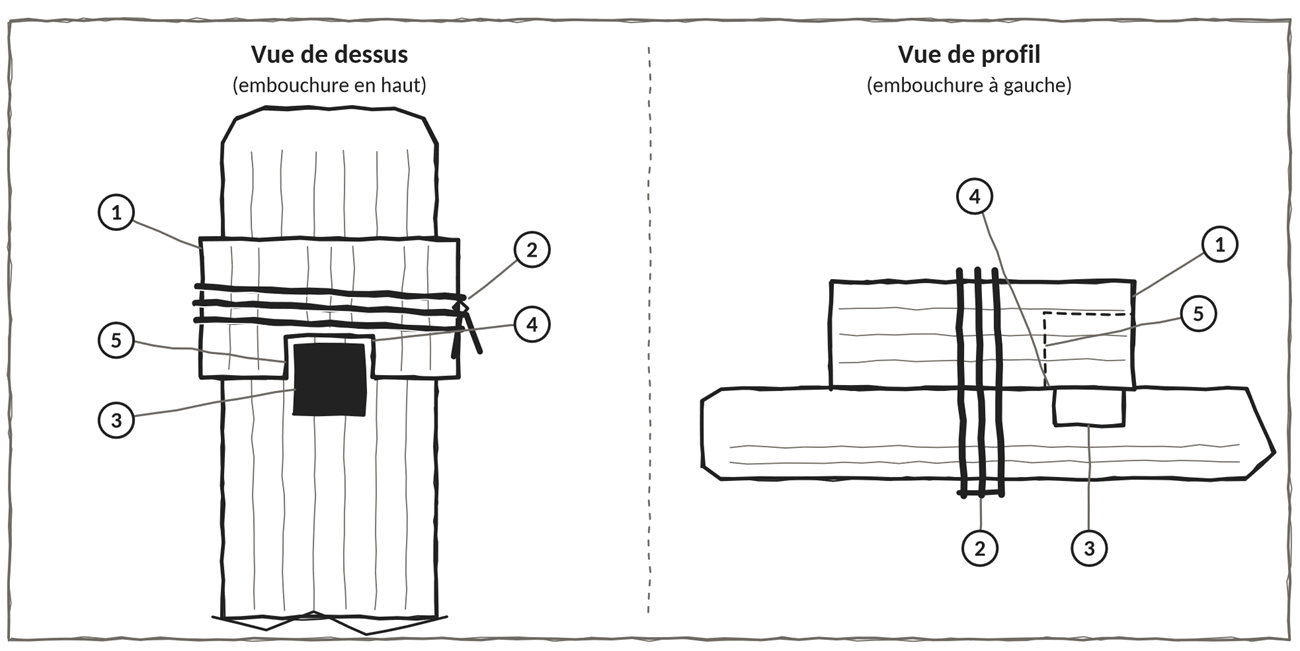
- 1Totem
- 2Leather lace tightly tied
- 3Sound hole, fully visible
- 4Visible margin of wood, about 1 mm
- 5Notch, just around the hole
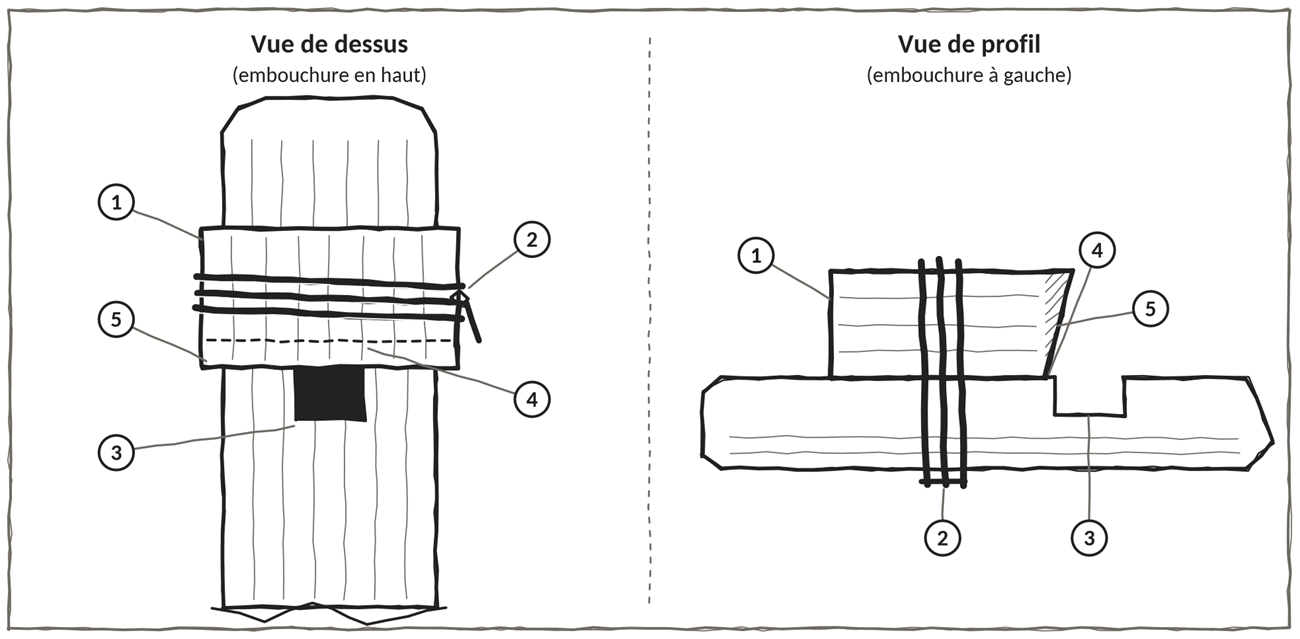
- 1Totem
- 2Leather lace tightly tied
- 3Sound hole
- 4Margin of wood between the bottom of the totem and the hole, about 1 mm
- 5Face sloping forward (the angle)
These diagrams come from the user guide included with each flute. Get the full guide as a PDF (in French)
Caring for your flute
After each session: clear out the moisture
Saliva and moisture are normal while playing. Clear them out after each session, with one of these methods:
- Through the sound hole: remove the totem, blow into the sound hole area, then put the totem back and tighten the lace.
- By shaking: hold the flute mouthpiece down, shake it gently, then wipe the mouthpiece.
- On its stand: turn the flute over, with the mouthpiece on the stainless steel rod, and let it drain for about 10 minutes.
Varnished flute
Nothing to do: the varnish protects the wood. If, over time, saliva ends up wearing the mouthpiece, simply apply a little grapeseed oil to it.
Oiled flute
Apply grapeseed oil to the mouthpiece when needed. Once a year, you can coat the whole flute using a soft cloth, let it soak in, then wipe off the excess.
Why grapeseed oil? It doesn’t go rancid and keeps the wood’s natural color.
Frequently asked questions
Your questions about the Native American flute
Another question? Write to me, I answer personally.
Do you need to know how to play music?
No. The flute is tuned to the minor pentatonic scale, where all the notes sound good together. Start with all the holes covered, then lift your fingers one by one, from the bottom up.
5 holes or 6 holes?
The traditional flute has 5 holes. On a 6-hole flute, keep hole 4 covered to play exactly as on a 5-hole flute. This extra hole then opens up other notes and more melodies.
My flute doesn’t sound right. What should I do?
First check the totem: the sound hole must stay fully visible, and the totem must stop about 1 mm from the hole and be tightly held. Blow gently: too much air makes the note “squeal”.
What’s the difference between a varnished flute and an oiled flute?
A varnished flute needs no care; just a little grapeseed oil on the mouthpiece if saliva ends up wearing it. An oiled flute gets this oil on the mouthpiece when needed, and on the whole flute once a year.
Which payment methods do you accept?
Credit card, with secure payment, Apple Pay and Google Pay, PayPal and bank transfer. For a custom flute, the deposit and the balance are paid the same way.
Do you ship to Belgium, Switzerland and all of Europe?
Yes. Shipping costs 12 € in France, 20 € in Europe and 40 € to the rest of the world, sent tracked and signed for as soon as payment is received.
Can I come and try the flutes?
Yes, at the workshop in Camaret-sur-Aigues, 10 minutes from Orange, by appointment only. The exact address is sent to you on confirmation. You can also find me at markets and events: see the calendar.
Can I order a custom flute?
Yes: choose the model, the key, the woods, the stone and the engraving in the custom questionnaire. Your request joins my waiting list and I get back to you to confirm everything. Allow about 2 months to make it, depending on demand. A 30% deposit confirms the order; the balance is paid before shipping.
The fingering chart and the guide to your flute
Sign up and receive the workshop’s two PDFs (in French): fingerings for all 12 keys, adjusting the totem, and care. Then, about once a month: new flutes before anyone else, a free score by Siyotanka, a composer for the Native American flute, and the workshop’s new videos.